
Portfolio
Conveyance Monitoring System
The Conveyance Monitoring and Predictive Recognition System (CMPRS) is a Department of Homeland Security initiative designed to support field operators with real-time monitoring, risk scoring, and data visualization across national port-of-entry operations. As Principal Human Factors Engineer, the role required navigating complex operational workflows, strict 508/WCAG compliance mandates, and the unique constraints of government software development.
Key Takeaways
- Sole Human Factors Engineer for the entire department, owning CMPRS from concept through six years of active development. About the Role ↓
- Direct access to CBP field operators informed every design cycle, building operational familiarity that eliminated guesswork over six years. Working with Operators ↓
- Grew from a focused tool into a nine-module platform spanning real-time maps, multi-tab analytics, inventory, and procurement, all unified under one design system. Platform Scope ↓
- 508 compliance treated as a floor, not a ceiling; CMPRS earned selection as the department's featured accessibility benchmark for a division-wide Lunch & Learn. Accessibility ↓
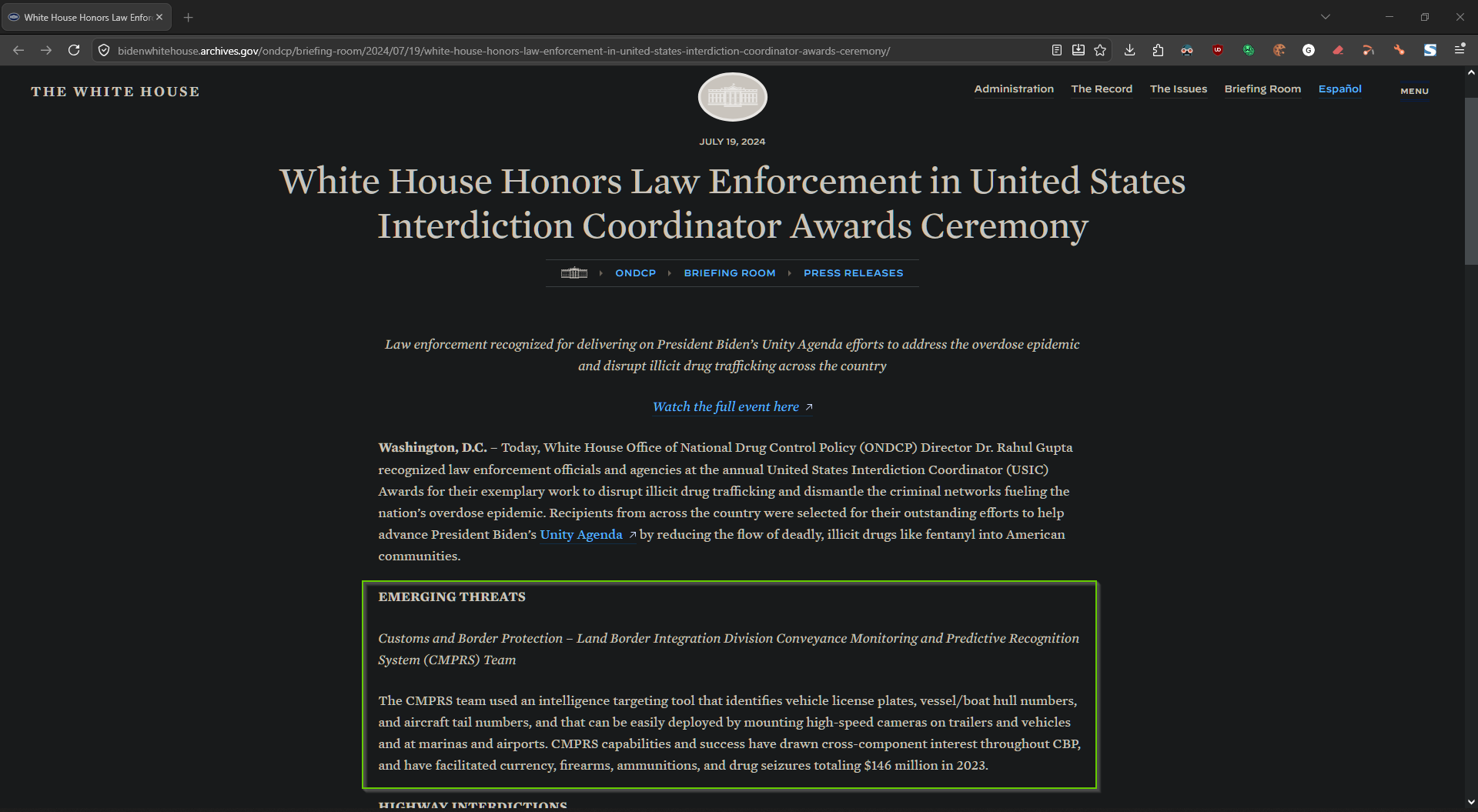
- Millions of query results surfaced and returned to agents daily at peak, recognized with a White House commendation for the platform's contribution to operational interdiction. Impact ↓
Due to the sensitive operational nature of this work, application screens and data visualizations have been intentionally omitted from this portfolio to protect the safety of field personnel and the integrity of active operations.
About the Role
As the sole Human Factors Engineer across the entire department, the scope extended well beyond a single project. In addition to serving as the principal UX designer on CMPRS, the position was regularly extended to other internal teams who needed human factors expertise but had no dedicated resource of their own. Within CMPRS, the work spanned the full platform lifecycle, covering everything from early interface concepts through iterative design, front-end implementation, 508 compliance, and ongoing platform evolution across six years of active development. The CSS architecture inherited from a prior agency system was rebuilt from the ground up to create a stable, scalable foundation capable of supporting the new platform's requirements. A dark mode was also designed and implemented at client request, since operators on late-night field shifts needed an interface that wouldn't be a liability in low-light environments.
Working with Operators
Unlike most enterprise UX projects where user access is filtered through proxies and product managers, this engagement included direct access to the Border Patrol agents and CBP field operators who actually used the platform. Regular sessions with key agent leads informed every stage of development, surfacing what was working, what wasn't, and what would meaningfully improve their workflow in the field. Over six years, the team built deep enough operational familiarity to anticipate next steps, frame productive questions before each session, and ensure each cycle of development moved the platform forward rather than revisiting solved problems.
Platform Scope
CMPRS grew from a focused tool set into a nine-module platform covering the full operational spectrum. The UX challenge scaled accordingly. The real-time Live module required a geospatial map interface with multi-dimensional filtering across sectors, stations, and unit types. The Analytics suite (the platform's most complex tool) combined a multi-tab search architecture, timeline scrubbers for cross-date range analysis, and heat-mapped read density visualizations across national locations. Inventory management spanned owned, loaned, and transferred assets across the organization, and was being consolidated with a requirements and procurement module: a purpose-built shopping cart workflow embedded in an operational context. Each of the nine tools carried its own interaction model and user mental model, all unified under a single design system.
Accessibility
508 compliance was a non-negotiable government requirement, but the approach treated it as a floor rather than a ceiling. WCAG standards informed every layer of the interface: keyboard navigation, color contrast ratios across both light and dark modes, screen reader compatibility, and accessible form controls throughout the filter-heavy search and analytics tools. On a platform used by agents in varying physical environments and conditions, accessibility wasn't abstract compliance work; it was part of ensuring the tool performed when it needed to.
The 508 compliance team coordinated standards testing with every release, and CMPRS became something of a benchmark within the department. Given the platform's technical complexity, testers consistently noted that it passed with flying colors, and on the rare occasion an issue was flagged, it was remedied quickly enough to earn a clean mark before the next cycle. That reputation earned CMPRS a distinction that no other project in the department held: the 508 team selected it as their featured example for a department-wide Lunch & Learn on accessibility best practices.
Impact
The platform's adoption tells the story. In early deployment, CMPRS was generating thousands of daily searches from agents operating across land ports of entry, interior checkpoints, sensor arrays, and roadside gantry positions spanning both border zones and inland enforcement corridors throughout the country. As the tool matured and its capabilities became known across the Border Patrol agent community, that volume grew to millions of query results surfaced and returned to agents daily, each one representing actionable intelligence delivered to a field operator tracking, identifying, and acting in real time. That adoption curve was earned: it was the result of a tool agents actually trusted, built around how they worked rather than how the system expected them to work. The program's operational contribution was recognized at the highest level: the CMPRS team received a White House commendation for the platform's role in successful interdiction efforts.